
1. Establish Clear Vision and Design Goals Before Construction Begins
Managing a high-end outdoor living project isn’t like managing a standard renovation. The stakes are higher, the budgets are larger, and the expectations for quality and craftsmanship are demanding. When you’re transforming a luxury estate’s outdoor environment, every detail matters—from the initial design concept to the final irrigation setup. We’ve guided hundreds of luxury homeowners through complex outdoor transformations across Long Island, and we’ve learned that success depends on structured, deliberate management practices that keep every stakeholder aligned and every phase executing flawlessly.
This guide walks you through the seven practices that separate exceptional outdoor living projects from mediocre ones. Whether you’re planning a complete estate renovation or a targeted pool and spa installation, these principles ensure your vision becomes reality without surprises, delays, or budget overruns.
The most costly mistake we see luxury property owners make is beginning construction before their vision is fully defined. Vague goals lead to scope creep, design changes mid-project, and decisions made in crisis mode rather than strategy mode.
Start by articulating what success looks like for your outdoor space. Are you building a resort-style retreat? A sophisticated entertainment hub? A functional family landscape that supports both relaxation and play? Define this before pencil hits paper. Work with designers who ask probing questions: How many guests do you typically entertain? What activities matter most to your household? What architectural style aligns with your home’s character?
We invest significant time in the discovery phase precisely because clarity here prevents chaos later. Document your aesthetic preferences, functional requirements, and non-negotiables. A homeowner who wants a Mediterranean-style outdoor kitchen will make different material and layout choices than one seeking modern minimalism. That distinction shapes everything downstream.
Reference specific elements you admire. Bring photos of pools you love, patios that inspire you, outdoor kitchens that function brilliantly. This tangible reference point ensures the design team understands your direction without relying on abstract descriptions.
Actionable takeaway: Before meeting with any designer or contractor, spend a week documenting your outdoor living priorities in writing. List the top three functions your space must serve, your preferred aesthetic direction, and any architectural or landscape elements that must be included. This clarity becomes your project compass.
2. Create a Detailed Timeline with Milestone Checkpoints
Luxury outdoor projects span weeks or months, and without a structured timeline, teams drift. Weather delays, material lead times, and the sequencing of different trades create genuine complexity. That’s why we build timelines that account for real-world variables, not optimistic fantasy schedules.
A robust timeline identifies major phases and assigns target completion dates to each. For example: design phase (weeks 1-4), permit acquisition (weeks 4-6), hardscape construction (weeks 7-10), pool installation (weeks 8-12), outdoor kitchen build (weeks 11-14), landscaping and irrigation (weeks 13-16), final details and client walkthrough (week 17). Each phase has a defined start and end, with dependencies identified.
Within each phase, establish milestone checkpoints where progress is verified before moving forward. After the excavation phase, does the pool shell meet grade? After masonry work, are stone patterns aligned with the design? These checkpoints catch problems early, when they’re still fixable without major rework.
Document which trades work in sequence versus parallel. Some work happens simultaneously (landscape prep while pool equipment is ordered), while other tasks must complete before the next phase begins (pool shell must cure before deck installation). A professional timeline maps these relationships clearly.
Actionable takeaway: Request a detailed project timeline that shows weekly phases, specific milestone dates, and the rationale for the sequence. If your contractor can’t explain why Phase B must follow Phase A, that’s a red flag about their planning depth.

3. Coordinate Multiple Trades and Specialists Effectively
Luxury outdoor spaces require mastery across multiple disciplines: pool and spa installation, masonry and stonework, outdoor kitchen design, landscape design, irrigation systems, electrical work, and general carpentry. When five different trades are working on the same project, coordination failures cascade quickly.
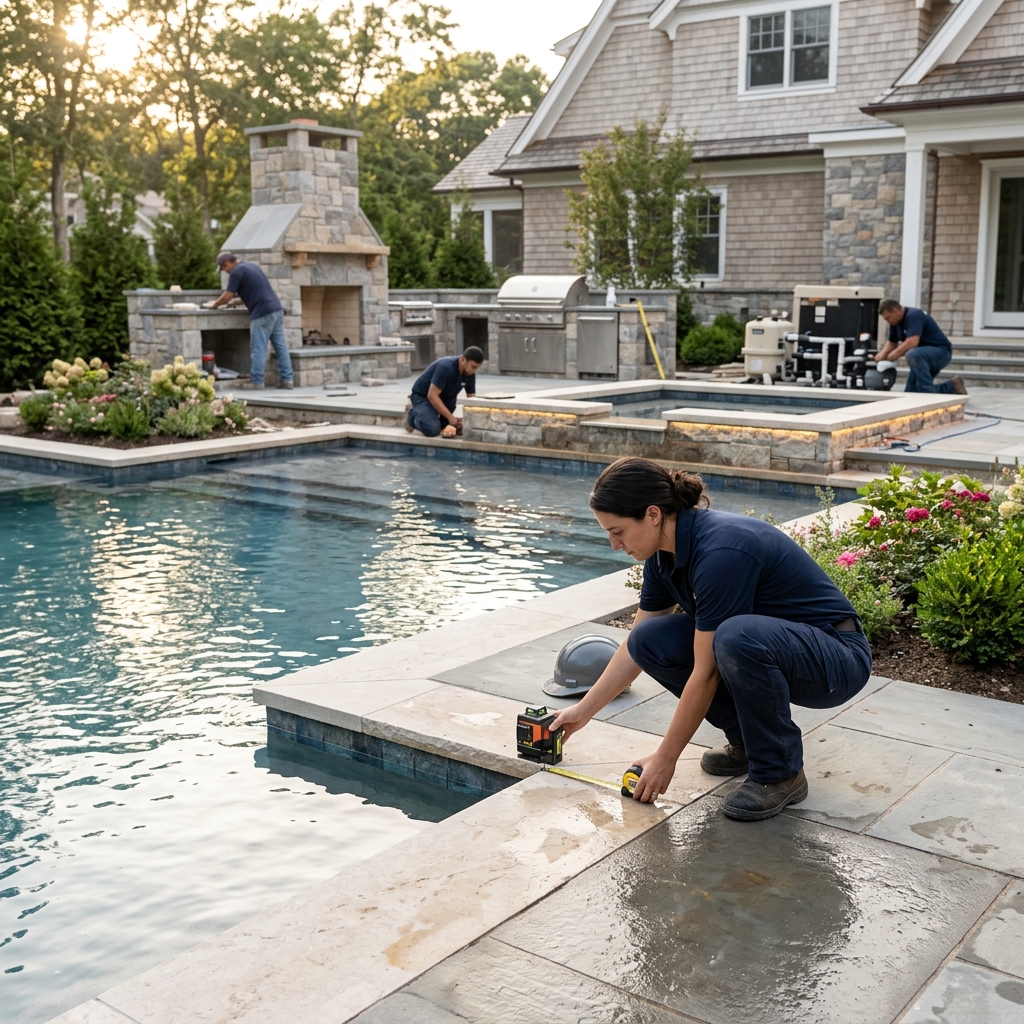
We treat our project manager as the hub that keeps all spokes functioning. This person manages the daily schedule, communicates with each trade about dependencies, verifies quality standards, and troubleshoots conflicts before they become disasters. Without this central coordination, you get the electrician showing up when the stone mason needs access to the wall, or the landscape crew arriving before the pool deck is fully cured.
Each trade needs clarity on what work precedes them and what constraints they’re working within. The stone veneer team needs to know exactly where the pool equipment will sit before they design the masonry wall. The outdoor kitchen installer needs electrical rough-in completed before they can set the gas line. The irrigation crew needs hardscape finalized before they can lay lines.
Weekly coordination meetings, even fifteen-minute standups, keep everyone aligned. We share what’s been completed, what’s starting, what obstacles emerged, and what’s needed from other trades. This regular touchpoint prevents teams from working in silos or assuming incorrectly about what others are doing.
Actionable takeaway: Insist on weekly coordination meetings with all trades present, whether in person or virtually. A project coordinator who can’t organize regular check-ins won’t catch problems until they become expensive.
4. Maintain Quality Control Throughout Every Phase
High-end outdoor living demands high-end execution. A 12×30 luxury pool isn’t just a bigger version of a standard pool. The finish, equipment selection, automation features, and integration with the surrounding hardscape require meticulous attention.
Quality control means inspecting work before it’s considered complete. After pool shell excavation, a professional inspection confirms depth, grading, and dimensions are accurate. After tile installation, we verify that grout lines are uniform and color matches the design. After landscape installation, we check that drainage functions correctly and plantings are positioned according to plan.
We build quality checkpoints into our project timeline. Rather than waiting until everything is finished to discover problems, we inspect phases as they complete. This approach catches issues when corrections are still manageable, not when they require tearing out finished work.
Documentation matters too. Photographs of each phase create a record of work progression and provide evidence if disputes arise later. Progress photos also serve as verification that promised specifications were met—for example, that the stone pattern truly matches the design proposal, or that the pool equipment installation matches the electrical plan.
Actionable takeaway: Ask your project team to schedule formal quality inspections at the end of each major phase, with photographic documentation. Request that you receive inspection reports before work proceeds to the next phase.
5. Manage Budget Transparency and Cost Optimization
Budget surprises poison luxury projects. A $10,000 overrun on a $500,000 outdoor transformation is manageable; a $100,000 surprise is a relationship destroyer. We prevent this through transparent tracking and deliberate cost management.
Every contract should specify labor costs, material costs, and a contingency reserve (typically 10-15% for unexpected conditions). As work progresses, track actual spending against budgeted amounts. If you’re halfway through the project and already 80% through your budget, that’s critical information that requires decisions now, not panic later.
Differentiate between value-adds and necessary costs. An upgrade to premium pool finishes costs more but delivers measurable quality. An unplanned retaining wall because soil conditions were worse than expected is an unavoidable cost. You make better decisions when you understand which category each expense falls into.
Material selections should happen early, not mid-project. Once the project is active, last-minute material changes create rush orders, longer lead times, and premium pricing. Select your stone, tile, pavers, and fixtures during the design phase so costs are locked in and materials are available when needed.
Actionable takeaway: Request a detailed cost breakdown at project start, showing labor and materials for each phase. Then request a monthly cost report tracking actual versus budgeted spending. If cumulative costs exceed budget midway through, you have time to make adjustments rather than face end-of-project shock.
6. Ensure Seamless Integration of All Outdoor Systems
A luxury outdoor space functions as an integrated ecosystem, not a collection of independent features. Your pool, spa, outdoor kitchen, irrigation system, landscape, and lighting all interact. When they’re not coordinated, you get problems: water runoff damages freshly planted beds, electrical supply doesn’t reach the outdoor kitchen, irrigation lines get damaged during hardscape work.
Integration planning happens during design. How does drainage from the pool deck flow to landscape beds? Where do electrical lines run, and are they protected from irrigation installation? How do sight lines from the kitchen toward the pool influence landscape placement? These questions must be answered in the design phase, not discovered during construction.
We coordinate systems by creating clear plans that show how each system interfaces with others. The irrigation plan shows where lines run relative to hardscape; the electrical plan shows how power reaches all fixtures; the drainage plan shows how water moves through the entire space. When trades reference these coordinated plans, they understand the bigger picture beyond just their portion of the work.
Post-installation, systems need to function together. Your pool automation system should integrate with landscape lighting. Your irrigation schedule should account for seasonal rainfall. Your outdoor kitchen’s drainage should connect logically to the pool area’s drainage. Integration during design prevents awkward retrofits later.
Actionable takeaway: Request an integration plan that shows how all major systems (pool, irrigation, electrical, drainage, hardscape) interact. Review this plan before construction starts to identify potential conflicts that can be resolved in design rather than during construction.
7. Deliver Exceptional Client Communication at Every Stage
The difference between a smoothly executed project and a frustrating one often comes down to communication. Homeowners want to feel informed, heard, and assured that their investment is progressing as planned. Radio silence breeds anxiety and frustration.
Establish a communication cadence from day one. Weekly or biweekly updates, depending on project intensity, keep you informed without overwhelming you. These updates should include progress photos, a summary of completed work, the next week’s planned activities, and any decisions needed from you.
Create a single communication channel. A project portal, shared email thread, or weekly call provides a consistent touchpoint. When homeowners have to hunt down project managers, coordinate across multiple contacts, or wait for responses, they feel disconnected from their own project.

Proactively surface decisions that need your input. Don’t wait until the last moment to ask about stone color or kitchen layout details. Flag these choices weeks in advance so you have time to deliberate and decide without rushing.
Be transparent about problems. If something isn’t tracking to timeline or budget, communicate that immediately with a proposed solution. Homeowners prefer early awareness of challenges and collaborative problem-solving over discovering issues too late to address them constructively.
Actionable takeaway: Confirm your communication preferences upfront. Request a specific day and time for updates, choose your preferred communication platform, and agree on response timeframes for decisions you need to make. Clear communication norms prevent misunderstandings and keep momentum strong.
—
Managing a luxury outdoor living project successfully requires discipline across planning, coordination, quality, and communication. These seven practices work together: clear vision prevents scope confusion, timelines coordinate execution, trade coordination prevents rework, quality control ensures excellence, budget transparency builds trust, system integration prevents failures, and client communication keeps everyone aligned.
When you partner with a team that applies these practices rigorously, your outdoor transformation becomes an asset that genuinely enhances your estate’s value and your family’s quality of life. At Monarc Creative Group, we’ve refined these practices across hundreds of high-end projects, and we embed them into every engagement. Your vision for an exceptional outdoor living space deserves a team committed to executing it flawlessly.
For further reading: Project portfolio.
Contact us today for a free estimate!
Frequently Asked Questions (FAQ)
How do we manage timelines for luxury outdoor projects to ensure they stay on schedule?
We break every project into clearly defined phases with specific milestone checkpoints so we can track progress and identify potential delays early. Our team coordinates all trades, from masonry specialists to irrigation technicians, using a synchronized schedule that prevents bottlenecks and keeps work flowing efficiently. We maintain regular communication with our clients about where we stand against our timeline and notify them immediately if any adjustments become necessary.
What process does our team follow to maintain quality across pools, kitchens, landscaping, and other outdoor components?
We implement comprehensive quality control inspections at every construction phase, from the initial site preparation through final system integration. Our specialists verify materials, craftsmanship, and functionality before moving forward, ensuring that your pool equipment, custom masonry, outdoor kitchen, and irrigation systems all meet our luxury standards. We don’t consider a project complete until every element performs flawlessly and integrates seamlessly with the overall design.
How do we keep clients informed throughout the project lifecycle?
We establish a communication framework at the start so our clients know exactly how and when they’ll receive updates from us. Our project managers provide regular progress reports, share before-and-after photos of each phase, and address questions or concerns promptly so there are no surprises. We believe that transparency about timelines, budgets, and construction decisions builds trust and ensures the final outdoor living space exceeds expectations.